

New owners ask us about training, about crates, about how soon the puppy can meet the neighbor’s dog.
Almost nobody asks what to feed, and of everything in the first year, food is the decision with the longest shadow. You can fix a bad habit at eighteen months. You cannot go back and re-grow a skeleton.
This is the part of puppy raising where doing less, more carefully, beats doing more.
Why a large breed puppy is a different animal
A Golden is a large breed dog. Veterinary nutrition generally draws that line at 70 pounds or more as an adult, and most European Goldens land in or near that range.
That matters because large breed puppies grow for a long time on a frame that is still soft. Their skeletons develop at their own pace, and if the body puts on size faster than the joints can mature, the mismatch shows up as developmental orthopedic disease. That umbrella includes hip and elbow dysplasia.
Here is the part that surprises people. This is not only about genetics.
A puppy from exceptional hips can still develop joint problems if it is grown too fast in the first year. The genetics set the ceiling, and how you raise the puppy decides how close to that ceiling you get.
Which means the food bowl is a health intervention, not just a chore.
Pick a food formulated for large breed growth
Not all puppy food is the same, and the difference is printed on the bag in small type.
Look for the nutritional adequacy statement, usually on the back near the feeding guide. For a Golden puppy you want language that specifically covers large size growth, phrased as including the growth of large size dogs (70 lb or more as an adult).
A food labeled only for growth, without that large size language, has not been formulated with the calcium control a large breed puppy needs. It is not poison. It is simply not the right tool.
The statement will also tell you how the food’s adequacy was established, either through AAFCO feeding trials or by formulation to AAFCO nutrient profiles. Both are legitimate. A feeding trial is the stronger version of the claim.
The calcium question
This is where large breed puppy food earns its name.
Large and giant breed puppies need much more tightly controlled calcium and phosphorus than other dogs. Too much calcium during growth is a problem in itself, independent of calories. The usual target for the calcium to phosphorus ratio is between 1.1 to 1 and 1.4 to 1.
Two practical consequences follow.
Do not add a calcium supplement. A complete large breed puppy food already has it balanced. Adding more is not insurance, it is interference. The same goes for most bone meal and dairy heavy additions.
Go easy on the extras. Excess protein raises phosphorus intake, which can pull the calcium number up with it. Toppers, table scraps and generous treat habits all shift the balance you paid for.
If you want to add anything at all, ask your vet first and ask specifically about the calcium number. That is the question that matters at this age.
How much, and how to tell
This is the single most useful thing in this article, so here it is plainly.
Feed to body condition, not to the number printed on the bag. The chart on the bag is a starting estimate for an average puppy. Your puppy is not an average puppy.
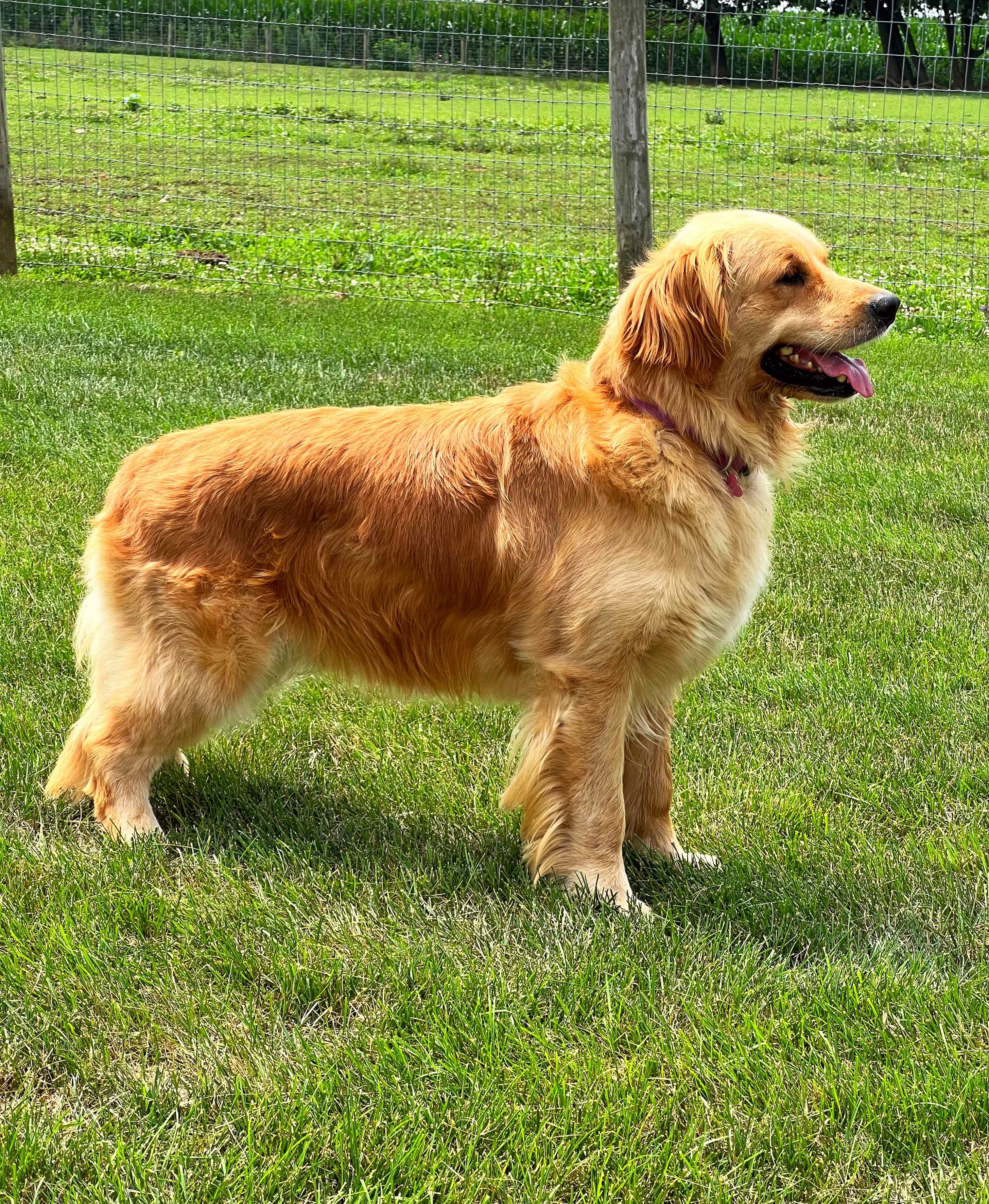
The target is a body condition score of about 4 out of 9, which is a touch leaner than most people are comfortable with. On a Golden puppy in that range you should be able to feel the ribs easily under a thin layer of covering without pressing, see a waist from above, and see a tuck from the side.
A puppy at 4 out of 9 looks slightly lean to a loving owner. A puppy that looks perfectly filled out and solid is usually a 6, and a 6 in a growing large breed is exactly the thing we are trying to avoid.
Overfeeding causes problems even when the diet itself is appropriate. The food can be right and the amount can still be wrong.
Weigh the food rather than scooping it, check the condition every couple of weeks by hand, and adjust by small amounts. Hands beat eyes here, especially on a coated breed where the coat hides a great deal.
How long to stay on puppy food
Large breed puppies generally stay on a growth formula until around 18 months.
Resist the urge to switch to adult food early because the dog looks grown. A Golden reaches most of its height well before it finishes maturing, and the frame is still doing work after the dog stops looking like a puppy. We covered the size and growth timeline in how big English Cream Golden Retrievers get.
When you do switch, do it gradually over a week or so, mixing increasing amounts of the new food into the old.
How to judge a brand
Marketing in this category is loud and most of it is about ingredients, which is the least informative part of the bag.
The World Small Animal Veterinary Association publishes a short guide on selecting a food, and its questions are better than anything on the front of a package. Paraphrased, the ones worth asking:
Does the company employ a qualified nutritionist, and who is it? WSAVA considers a PhD in animal nutrition or board certification through ACVN or ECVCN to be appropriate credentials.
Who formulates the diets, and what are their credentials?
What quality control does the company run on ingredients and finished product?
Has the company published research in peer reviewed journals?
Does the company make its own food, or is it made for them by someone else? The label will say “made by” versus “made for” or “distributed by.”
Can you call them and get a full nutrient analysis?
WSAVA’s own guidance is that if a manufacturer cannot or will not answer these, that is a reason for caution. A company proud of its answers will give them to you in one phone call.
A few practical habits
Keep meals scheduled rather than free feeding. Scheduled meals let you see what the puppy actually ate, which is often the first sign that something is off.
Count treats as food. Training treats during the first year add up fast. Keep them small and subtract them from meals.
Slow down a fast eater. A puzzle bowl is cheap and useful for a breed that inhales dinner.
Fresh water, always. Unremarkable advice, universally skipped during house training because owners want to control the bladder. Control the schedule instead.
Talk to your vet at every puppy visit. Bring the bag or a photo of the label. Ask whether the growth curve looks right. That is a two minute conversation that prevents expensive ones later.
Why we care about this part
We put real work into the genetics behind our puppies. Health clearances, published testing, European lines chosen for structure and temperament. You can see all of it on our Meet Our Family page.
Then the puppy goes home, and the next twelve months are yours.
Good nutrition in that window is how the genetics we selected for actually get expressed. It is the single biggest lever a new owner has, and it is mostly a matter of choosing the right bag and being disciplined about the amount.
If you are preparing for a puppy, transitioning your puppy into your home covers the first days, and the importance of exercise covers the other half of growing a sound dog, which is knowing how much activity is appropriate while joints are still developing.
Questions about feeding one of our puppies specifically? Call us at (717) 682-4282 or get in touch. We would rather answer it now than hear about it at a year.
This post is general information, not veterinary advice. Every puppy is different and nutritional needs vary. Talk to your veterinarian about the right diet and feeding amount for your dog.