

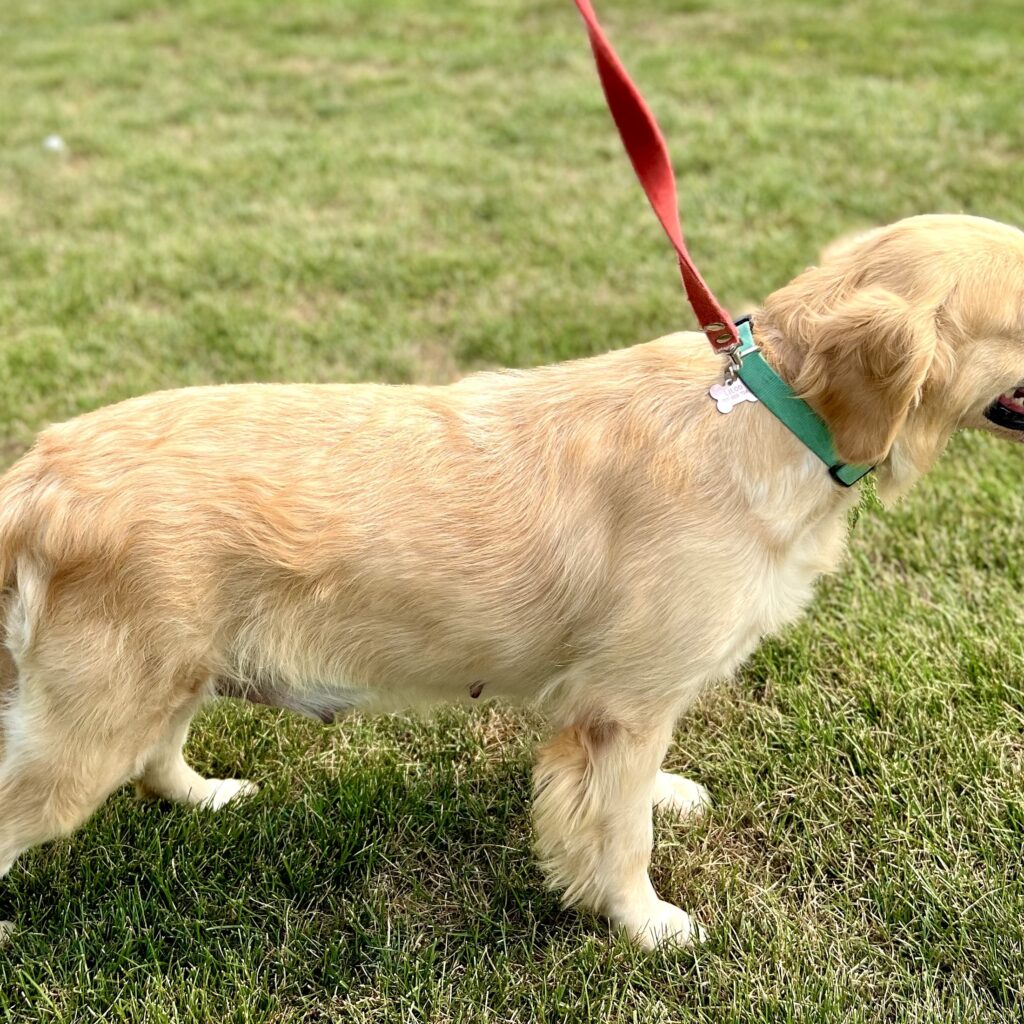
The breed’s greatest quality creates its most common behavior problem.
A Golden Retriever was bred to work in partnership with a person, close by, all day. That is why they follow you to the bathroom. It is why they are wonderful with children and easy to train.
It is also why being left alone does not come naturally, and why it has to be taught rather than assumed.
Start before you need it
The mistake almost everyone makes is understandable. A new puppy arrives, the family is home, often someone has taken time off, and the puppy is never alone for the first two weeks.
Then real life resumes on a Monday morning, and the puppy experiences eight hours of solitude for the first time, with no preparation.
Practice absence from day one, while someone is still home.
Put the puppy in the crate or pen with something good to chew and walk out of the room for two minutes. Come back without ceremony. Do it again later for five minutes.
Build up in small steps across the first weeks:
- Go sit in the car for a few minutes
- Go to the mailbox and back
- Go to the store for twenty minutes
The goal is for alone to be ordinary long before it is unavoidable.
Make arrivals and departures boring
This is the single easiest adjustment and it does real work.
The emotional goodbye, the long cuddle, the apologetic voice at the door, all of it teaches the puppy that your leaving is a significant event worth getting worked up about.
Leave without a word. Come home and ignore the dog for a minute or two until they are calm, then greet them.
It feels cold and it is not. You are telling the dog, in the only language that works, that this is nothing.
Separate the two common problems
A dog that is unhappy when left alone is usually dealing with one of two things, and they need opposite solutions.
Boredom and under-exercise. A young Golden with unspent energy and nothing to do will chew, dig and bark. This dog is not anxious. This dog needs a job.
Genuine anxiety. This is panic, not mischief. The signs are distress that starts as you prepare to leave, destruction concentrated at exits and doorframes, drooling, house soiling in an otherwise trained dog, and vocalizing that continues rather than settling.
The tell is timing and location. A bored dog destroys the interesting thing in the middle of the room, at some point during the day. An anxious dog destroys the door, in the first thirty minutes.
VCA’s overview of separation anxiety in dogs is a good description of the real thing if you are trying to tell which you have.
If it is boredom, the fix is exercise, mental work and something to chew. The importance of exercise for your puppy covers how much is appropriate at different ages, because a young dog can be under-exercised and over-exercised in the same week.
Build the alone skill properly
If your dog is already uncomfortable, the approach is gradual and unglamorous.
Work below the threshold where the dog panics. If two minutes is fine and five minutes is not, you work at two and add thirty seconds.
Break up the departure cues. Pick up your keys and sit down. Put your coat on and make coffee.
Open the front door and close it again. Repeat these until they stop predicting anything.
Give the dog something that takes time and tastes good, delivered as you leave. A stuffed frozen toy turns your departure into the start of something rather than the end of something.
Leave a camera running. Phone footage of the first thirty minutes tells you more than guessing ever will, and it is how you find out whether the dog settles at minute four or never settles at all.
Do not use the crate to contain a panicking dog. A dog in genuine distress can injure itself trying to get out, and you will have taught it to fear the crate on top of everything else.
A dog that is comfortable in its crate is a different story. That is why the groundwork in crate and house training and in VCA’s crate training guide is worth doing properly.
Get help earlier than feels necessary
True separation anxiety rarely resolves on its own and it tends to get worse with repeated exposure to the thing that panics the dog.
Talk to your veterinarian. There are medical causes that mimic it, and for real cases there are medications that make the behavior work possible rather than replacing it.
A veterinary behaviorist or a qualified trainer who uses reward-based methods is the next call. Punishment makes anxiety worse without exception, and a dog punished for panicking simply adds you to the list of things to worry about.
Be honest about the household
Some of this is a planning question rather than a training one.
A Golden is not a breed that does well alone for ten hours a day, five days a week. That is worth knowing before the puppy arrives rather than after.
If your household has long away days, build in a midday break, a walker, or daycare for part of the week. Plenty of working families raise very happy Goldens. They do it by arranging the day around the dog, not by hoping the dog adjusts.
We talk through this honestly with families before placement, which is part of what we mean on how to spot a great European Golden Retriever breeder. A breeder who never asks about your schedule is not doing the job.
The reassuring part
The large majority of Goldens learn this easily, as long as somebody teaches it.
Ten minutes of practice a day in the first month, boring departures, enough exercise and something good to chew, and you end up with a dog that watches you leave, sighs, and goes back to sleep.
That is the normal outcome. The dogs that struggle are usually the ones that were never given the chance to practice.
Questions about settling your Rockvale puppy in? Call (717) 682-4282 or get in touch. We would much rather help in week one than hear about it in month six.
This post is general information, not veterinary or behavioral advice. Separation anxiety is a clinical condition. Consult your veterinarian or a veterinary behaviorist if you suspect your dog has it.


